Search has changed dramatically since the early days of the web.
What once involved carefully placing keywords on a page, adding a few meta tags, and submitting a sitemap has evolved into something much broader. Search engines have become remarkably good at understanding the meaning and context of content, while people are increasingly finding information through traditional search results, AI-powered search features, maps, images, videos, and other experiences.
The good news? The fundamentals haven’t disappeared.
In fact, many of the most important principles of SEO are surprisingly simple: create useful content, make your website easy to understand, and make sure search engines can access and interpret it.
The challenge is putting those principles into practice.
SEO Is More Than Keywords
One of the biggest misconceptions about SEO is that success comes from identifying a handful of keywords and repeating them throughout your website.
Keywords still matter. They help communicate what a page is about. But modern search engines understand language, context, related concepts, and the intent behind a search much better than they did years ago.
Consider someone searching for:
“website accessibility for small business”
They may actually be looking for information about ADA compliance, accessible navigation, color contrast, keyboard accessibility, accessible forms, or the business implications of an inaccessible website.
A strong page doesn’t need to repeat the exact phrase “website accessibility for small business” dozens of times. Instead, it should answer the questions the visitor is actually trying to solve.
The goal isn’t to write for an algorithm.
The goal is to create the best answer for the person behind the search.
Google’s current guidance emphasizes valuable, original, people-first content and specifically warns against creating large amounts of low-value content primarily to manipulate search rankings.
1. Start With Useful, Original Content
Content remains one of the most important parts of an SEO strategy—but “more content” isn’t necessarily better.
A website with 20 pages of generic, repetitive content isn’t automatically more valuable than one with 5 well-developed pages.
Good content should demonstrate that you understand your audience and the problems they are trying to solve. It should answer real questions, provide useful information, explain your expertise, or offer a perspective that visitors can’t easily get somewhere else.
For an organization with years of experience, that last point is particularly important.
Your experience is an asset.
Case studies, lessons learned, technical explanations, project insights, original research, examples, and firsthand expertise can provide something that a generic article generated from information already available across the internet cannot.
That kind of content is useful to people—and increasingly important as search evolves.
2. Understand Search Intent
Before optimizing a page, ask a more fundamental question:
What is someone actually trying to accomplish when they search for this topic?
Someone searching for “WordPress website development” may be researching how WordPress works. Someone searching for “WordPress developer Wisconsin” may be looking for a company to hire. Someone searching for “how to optimize WordPress” may be trying to solve a specific problem themselves.
Those are very different intentions.
Your content should match the intent behind the search.
That might mean creating an educational article, a service page, a comparison, a case study, a local landing page, or a detailed guide.
SEO works best when it connects the right content with the right audience—not when every page is optimized to rank for as many keywords as possible.
3. Give Every Page a Clear Purpose
Your website should have a logical structure that makes sense to both visitors and search engines.
Every important page should have a reason to exist.
That starts with a descriptive page title and a clear heading structure. Your content should make it obvious what the page is about, what questions it answers, and how it fits into the larger website.
Think of your website as an outline:
- Your navigation establishes the major topics.
- Your page titles identify specific subjects.
- Your headings organize the discussion.
- Your content provides the details.
- Internal links connect related information.
This structure helps visitors navigate your website while also helping search engines understand the relationships between your pages.
4. Don’t Forget the Technical Foundation
Great content can’t do much if search engines can’t properly access your website.
Technical SEO includes the behind-the-scenes elements that allow search engines to crawl, understand, and index your site.
Some important fundamentals include:
- A crawlable website structure
- Search-engine-friendly URLs
- Descriptive page titles and meta descriptions
- Proper heading hierarchy
- Internal links between related pages
- An XML sitemap
- Appropriate robots.txt directives
- Mobile-friendly layouts
- Fast, reliable page performance
- Secure HTTPS connections
- Canonicalization and management of duplicate content
- Structured data where it is appropriate
An XML sitemap can help search engines discover the pages on your site, particularly on larger or frequently updated websites. But a sitemap is not a shortcut to rankings or a guarantee that every URL will be indexed.
Technical SEO is about removing unnecessary barriers—not trying to trick search engines into ranking a page.
5. Treat Images as Part of the Experience
Images are important for both people and search.
Use descriptive file names where appropriate, choose useful image formats and sizes, and make sure images are optimized so they don’t unnecessarily slow down the page.
And don’t forget accessibility.
Alternative text should describe the meaningful content or purpose of an image when the image conveys information. It shouldn’t be treated as a place to stuff keywords.
For example, an image of a company’s team might appropriately have alt text such as:
“Lanex team members collaborating around a conference table.”
That’s more useful than something like:
“web development company Wisconsin SEO website development software company.”
SEO shouldn’t come at the expense of accessibility or usability.
6. Connect Your Content
A website isn’t a collection of isolated pages.
When you publish a new article, look for opportunities to connect it to related services, projects, resources, and other articles on your website.
For example, an article about website accessibility could link naturally to your ADA Compliance service. A post about improving application performance could connect to Application Development or Database Optimization.
These links help visitors discover related information and help search engines understand how the content on your website fits together.
A strong internal linking structure can also make your website easier to navigate as it grows.
7. Don’t Ignore the User Experience
Search engines don’t exist in a vacuum.
A visitor who clicks through from search results still needs to have a good experience once they arrive.
Is the page readable on a phone?
Does it load quickly?
Can visitors easily find what they’re looking for?
Are links and buttons obvious?
Is the content organized logically?
Can someone using a keyboard or assistive technology navigate the page?
SEO, accessibility, performance, and user experience increasingly overlap.
A website built only for search engines isn’t a successful website. It needs to work for the people who actually use it.
8. Search Is Expanding Beyond the Traditional Results Page
One of the biggest changes in recent years has been the way people find information.
Search engines now incorporate AI-generated answers and other generative experiences alongside traditional results. Google says its AI Overviews and AI Mode continue to rely on the same foundational SEO principles used throughout Search: technically accessible websites, helpful and reliable content, clear structure, and information that provides genuine value. There isn’t a separate “AI SEO” trick that replaces those fundamentals.
That doesn’t mean SEO is becoming irrelevant.
It means the definition of visibility is expanding.
A useful page may be discovered through a traditional search result, referenced in an AI-generated answer, surfaced through an image search, found through a local result, or reached through another search experience.
The organizations best positioned for that changing landscape are the ones building genuinely useful websites rather than chasing every new optimization trend.
9. Measure, Learn, and Adapt
SEO isn’t a one-time project.
Search behavior changes. Your organization changes. Your competitors change. Your content becomes outdated. Search engines continue to evolve.
That’s why ongoing measurement matters.
Tools such as Google Search Console can help you understand how your website is appearing in search, which queries are bringing visitors to your site, which pages are performing well, and where there may be opportunities for improvement.
Analytics can provide another layer of insight by showing what visitors do once they arrive.
The objective isn’t simply to watch a ranking number go up.
It’s to understand whether the people you’re trying to reach are finding your website, engaging with your content, and taking the actions that matter to your organization.
10. Be Wary of SEO Shortcuts
If someone promises that a particular trick will guarantee first-page rankings, it’s worth being skeptical.
There will always be a new tool, tactic, acronym, or “secret” that promises to unlock search visibility.
Some tools can be extremely useful. But no legitimate SEO strategy can guarantee a specific ranking position, and third-party tools don’t have access to Google’s internal ranking systems.
Likewise, generating large amounts of generic content simply because you believe more pages will mean more rankings is not a sustainable strategy. Google explicitly considers large-scale, low-value content created primarily to manipulate search rankings to be a form of spam.
The best long-term strategy is considerably less exciting:
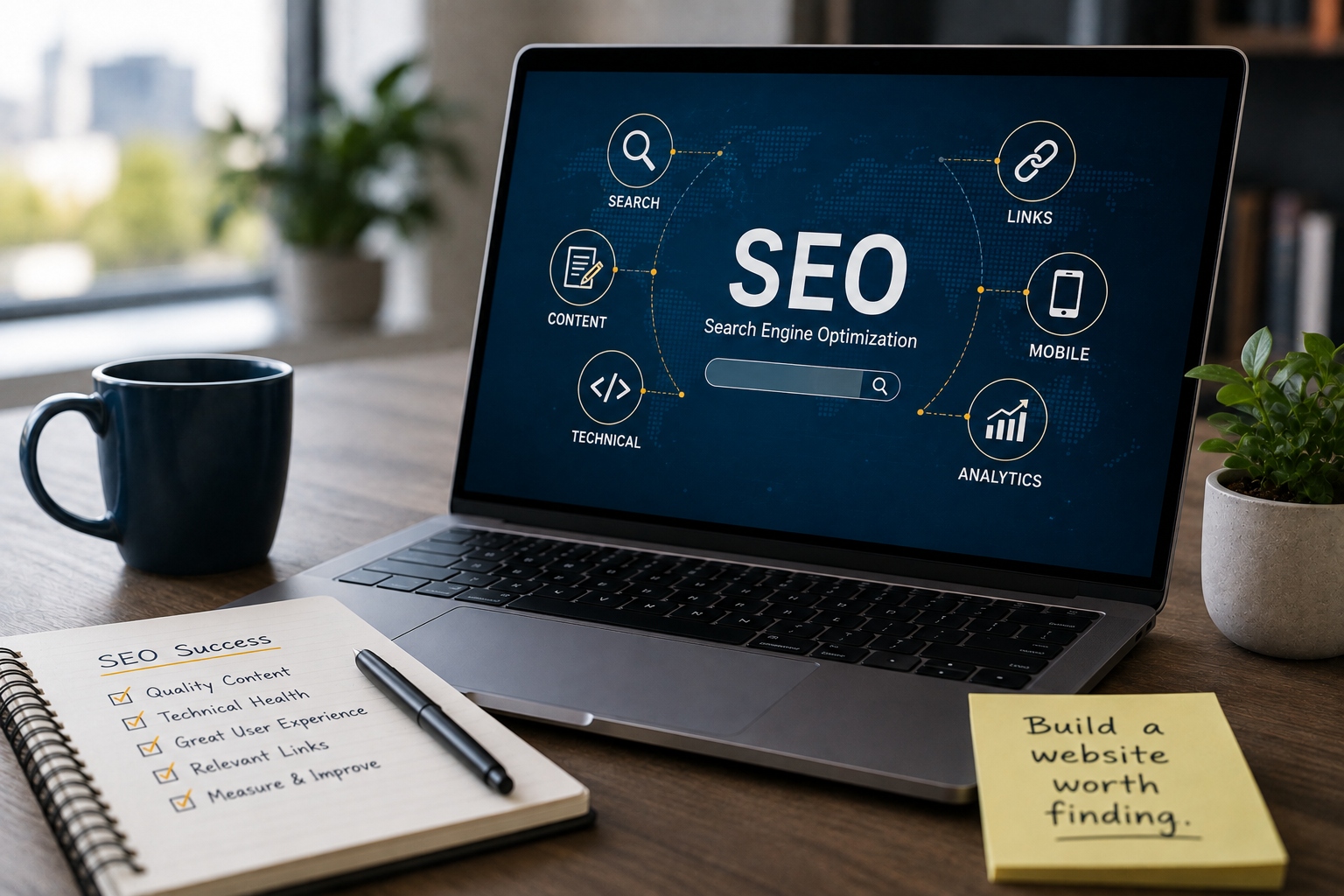
Build a website worth finding.
SEO Is a Strategy, Not a Checklist
There will always be technical details to consider, and SEO best practices will continue to evolve.
But the foundation is remarkably consistent.
Understand your audience.
Create useful content.
Organize your website clearly.
Make your pages accessible and technically sound.
Connect related information.
Provide a good user experience.
Measure what is working.
Adapt as the search landscape changes.
At Lanex, we don’t think of SEO as something that gets sprinkled onto a finished website at the end of a project.
It should be considered alongside strategy, content, design, development, accessibility, and performance from the beginning.
Because the goal isn’t simply to get someone to find your website.
It’s to make sure they find something worth finding.